
Indice degli argomenti
Secondo J.H.B. Latrobe (1803-1891, autore, avvocato, artista e inventore) Poe inviò questo racconto a un premio indetto dal «Baltimore Saturday Visiter» nel 1833, ma la maggior parte degli studiosi lo liquida come un errore.
Il racconto “A Descent into the Maelström” fu comunque pubblicato nel 1841 sul «Graham’s Magazine». Apparve poi, nel 1845, nella raccolta Tales.
Le fonti per il racconto usate da Poe
Arlin Turner, nel suo “Sources of Poe’s A Descent into the Maelstrom”, presente nel volume The Journal of English and Germanic Philology (luglio 1947), ha individuato alcune fonti che potrebbe avere utilizzato Poe per scrivere il racconto “Una discesa nel Maelstrom”.
Encyclopaedia Britannica. Poe ha citato dei passaggi dall’articolo sul Maelstrom, consultando il volume 10 della terza edizione, del 1797. Lo stesso Jonas Ramus, menzionato nel racconto, è presente proprio in quell’articolo.
Ecco un passo interamente preso da Poe dall’Encyclopaedia Britannica:

Che ritroviamo, con pochissime modifiche, nel racconto, quasi all’inizio:
“Between Lofoden and Moskoe,” he says, “the depth of the water is between thirty-six and forty fathoms; but on the other side, toward Ver (Vurrgh) this depth decreases so as not to afford a convenient passage for a vessel, without the risk of splitting on the rocks, which happens even in the calmest weather. When it is flood, the stream runs up the country between Lofoden and Moskoe with a boisterous rapidity; but the roar of its impetuous ebb to the sea is scarce equalled by the loudest and most dreadful cataracts; the noise being heard several leagues off, and the vortices or pits are of such an extent and depth, that if a ship comes within its attraction, it is inevitably absorbed and carried down to the bottom, and there beat to pieces against the rocks; and when the water relaxes the fragments thereof are thrown up again. But these intervals of tranquility are only at the turn of the ebb and flood, and in calm weather, and last but a quarter of an hour, its violence gradually returning. When the stream is most boisterous, and its fury heightened by a storm, it is dangerous to come within a Norway mile of it. Boats, yachts, and ships have been carried away by not guarding against it before they were within its reach. It likewise happens frequently, that whales come too near the stream, and are overpowered by its violence; and then it is impossible to describe their howlings and bellowings in their fruitless struggles to disengage themselves. A bear once, attempting to swim from Lofoden to Moskoe, was caught by the stream and borne down, while he roared terribly, so as to be heard on shore. Large stocks of firs and pine trees, after being absorbed by the current, rise again broken and torn to such a degree as if bristles grew upon them. This plainly shows the bottom to consist of craggy rocks, among which they are whirled to and fro. This stream is regulated by the flux and reflux of the sea — it being constantly high and low water every six hours. In the year 1645, early in the morning of Sexagesima Sunday, it raged with such noise and impetuosity that the very stones of the houses on the coast fell to the ground.”
Tuttavia l’articolo sul maelström non suggerì a Poe l’idea per il racconto né come portare il suo personaggio sano e salvo attraverso il maelström per poter raccontare la sua avventura, ma soltanto le informazioni geografiche per renderlo credibile.
«New York Magazine». Anche questo giornale, che difficilmente viene accreditato ad avere legami con Poe, potrebbe essere stato una fonte, poiché l’articolo “Account of the Maesltroom” del dicembre 1791 contiene similarità con il racconto.
“Le Maelstrom”. Era una storia anonima pubblicata su «Le Magasin Universel» di Parigi nell’aprile 1836 e presenta elementi simili al racconto di Poe:
- Un sopravvissuto al vortice
- Il racconto della sua esperienza e le sensazioni provate
- Il Monte Helseggen
Secondo Julio Cortázar il racconto “Le Maelstrom” è stato ispirato a “The Maelstrom – A Fragment”, apparso nel settembre 1834 sulla rivista londinese «Fraser’s Magazine for Town and Country».
L’originalità del racconto di Poe
Nonostante queste 3 fonti – di cui soltanto l’Encyclopaedia Britannica è certa – il modo escogitato da Poe per salvare il suo personaggio dal vortice nel racconto “Una discesa nel Maelstrom” fu originale.
Nell’edizione della raccolta Tales, infatti, Poe inserisce una nota al brano seguente, per spiegare ai lettori l’espediente escogitato per salvare il personaggio:
He explained to me — although I have forgotten the explanation — how what I observed was, in fact, the natural consequence of the forms of the floating fragments — and showed me how it happened that a cylinder, swimming in a vortex, offered more resistance to its suction, and was drawn in with greater difficulty than an equally bulky body, of any form whatever.*
See Archimedes, “De Incidentibus in Fluido.” — lib. 2.
Pubblicazioni estere del racconto
- Londra, nel 1841, sul Carpenter’s Penny Book col titolo “In a Maelström”
- Francia, nel settembre 1846, su Revue britannique col titolo “Une Descent Au Maelstrom”
- Germania, il 17 e il 24 aprile 1852, sul Bremischer Beobachter col titolo “Der Mahlstrom”
- Danimarca, il 30 giugno e il 7 luglio 1867, su Figaro col titolo “I Malströmmen”
- Italia, nel 1876, nella raccolta Racconti Incredibili, col titolo “Una discesa nel Maelstrom”
- Svezia, nel 1881, nella raccolta Underliga historier, col titolo “En nedfart i malströmmen”
- Olanda, circa nel 1930, nella raccolta Fantastische Vertellingen van Edgar Allan Poe col titolo ”De Neerdaling in den Maalstroom”
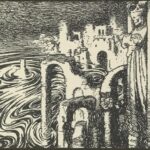
Illustrazioni del racconto “Una discesa nel Maelstrom”


Fonti
- “Sources of Poe’s A Descent into the Maelstrom”, Arlin Turner, The Journal of English and Germanic Philology, Vol. 46, No. 3 (Luglio, 1947)
- Encyclopaedia Britannica, Third edition, Volume 10, LES-MEC, 1797
- A Forerunner of “A Descent into the Maelström”, David E. E. Sloane, The Edgar Allan Poe Review, Vol. 21, No. 1 (2020)



Commenta per primo